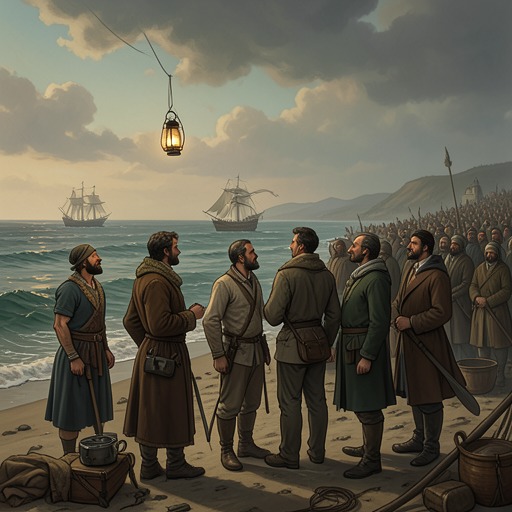
Emigration as Escape
The EmigrantsEmigration as Escape names the force that gathers a disparate company from Ljuder Parish into a single transatlantic journey. Their motives are not interchangeable: the fertile land and freedom imagined in America matter, but many leave chiefly to get away from crop failure, debt, persecution, exclusion, or personal entanglements at home. The novel makes departure both a hope for another life and a response to conditions that have narrowed the possibilities of this one.
An Old Order and a New Possibility
For generations, rural life had seemed to turn within a settled cycle: people were born, married, worked, and died beneath the same roofs, while the fields changed with the seasons. By the middle of the nineteenth century, that apparent permanence was being unsettled. New forms of transport brought distant places closer, and printed accounts made a faraway country imaginable as a real destination rather than a place in legend. News and rumor travelled through hamlets and parishes, taking root in people who had never seen the land they were being told about.
The attraction had a concrete counterpart in the conditions of the Swedish countryside. The land was divided among owners, while people without land became servants; plots dwindled as families grew, and food was scarce in communities bound to inherited customs. America seemed to offer fertile soil to those willing to till it, and the possibility of freedom denied at home. Yet the novel distinguishes the pull of that prospect from the pressure to leave. Some emigrants hoped for land or opportunity; others were trying to escape poverty, debt, religious persecution, civil authority, unfair employment, social ostracism, or private dilemmas. They did not all emigrate toward the same imagined reward. Some were emigrating, in the novel’s formulation, not to something but from something.
A Group Made of Different Pressures
The company from Ljuder Parish represents group emigration, a movement that commonly involved people joining together to begin farming or religious settlements in America. Their shared route does not erase the different circumstances that set each person in motion. The group is a small-scale portrait of an era precisely because its members have little in common beyond their dissatisfaction with life at home. The collective departure is therefore not the expression of a unified plan so much as the convergence of distinct pressures, hopes, and personal difficulties.
The contrast between Karl Oskar Nilsson and Robert Nilsson makes the variety of those pressures especially clear. Karl Oskar is practical, strong, and knowledgeable about farming, and he sees the American frontier as a place where his labor might produce a better future. Robert, by contrast, is drawn to books and daydreams, but his immediate sense of America grows from the restrictions of his life as a farmhand. Reflecting on the roads near Nybacken, he imagines that taking the road away from his service could make him disappear from the parish. He has heard that a man who leaves without trace may be entered in the church records under “End of the Parish”; the fate of Fredrik Emanuel Thron, a farmhand missing since 1833, makes disappearance seem possible. After Jonas Petter tells of Fredrik’s journey to America, Robert connects the distant country with the possibility of escape from service and from the local community’s reach. America becomes not only a destination but a way to take the road that does not lead back to Nybacken.
Hope Tested by Uncertainty
Karl Oskar’s decision is shaped by the failure of the life he has tried to build at Korpamoen. After four years there, he and Kristina are several hundred riksdaler poorer, despite spending their strength on the farm. Remaining, he fears, would mean laboring until they were broken, with only the reserved room and its meager bread to show for their effort. The hardship makes emigration more than an adventurous preference: it offers an alternative to a future of continued work without improvement.
Kristina sees the same choice from the other side. Her attachment to home and her husband’s confidence in America pull in opposite directions, and the promise of land does not persuade her by itself. No authority in the United States has written to them or promised them soil; they have no deed to land awaiting them, and have never met anyone who has seen North America and could report on it firsthand. Printed accounts and newspaper words cannot supply the reliable assurance she wants. Her hesitation exposes the gap between the emigrants’ imagined future and what they can actually know before setting out: the destination is compelling, but the journey rests on uncertain information and trust.
That uncertainty is made material in the preparations. Karl Oskar and Robert secure passage on the Charlotta, a merchant vessel bound directly from Karlshamn to New York, and pay a down payment of one hundred daler for six passengers. Spring is preferred because the worst winter storms have passed and arrival should leave time to till and sow before the first winter. Karl Oskar’s wider household is not the only one joining the venture: Danjel asks Robert to obtain a passage contract for his party if the ship has room, and nine people from Kärragärde, including children and household members, are to travel with him.
The Price and Form of Departure
Leaving requires selling the life the emigrants hope to escape. Karl Oskar sells Korpamoen for less than he paid, because the emigrant must sell while the prospective buyer can refuse. The cattle bring good prices amid a shortage after enforced slaughter during the famine year, but the auctioneer keeps a quarter of the proceeds for advancing the money. After debts and the mortgage are deducted, the family has twelve hundred daler. Their passage costs six hundred and seventy-five daler for three adults and three children, leaving Karl Oskar about five hundred daler before the entrance fee and the unknown cost of reaching a settlement. He hopes to acquire land cheaply, but little will remain for farm implements and cattle. The expense is not an incidental obstacle: it makes the desired escape a gamble with the resources needed to begin again.
The money that remains is sewn by Kristina into a sheepskin bag, which Karl Oskar can fasten to his belt and carry next to his body. The image is a compact measure of how thin the margin is between the old life and the hoped-for new one: their security must travel with them, concealed and physically guarded. Karl Oskar also chooses to leave openly. Although a person of good character can depart without petitioning the King or even obtaining a parish-register extract, he goes to Dean Brusander for his papers rather than vanish as Robert must, marked by his escape from service. The journey can signify freedom, but its beginnings remain shaped by the distinctions and constraints of the society being left behind.
At Åkerby Junction, the separate decisions become a visible migration party. There are nineteen people in all: sixteen emigrants, nine adults and seven children, while three drivers are to return from Karlshamn. Danjel travels with his wife, four children, and Ulrika of Västergöhl; Jonas Petter travels with his farmhand, and Arvid and Elin ride with him because Danjel’s wagon has no room. Robert and Arvid, once fellow farmhands at Nybacken, find themselves travelling together after all, though not by the secret departure they had imagined. Their escape has become a group undertaking, with shared transport and a negotiated question of leadership.
Passage and the Meaning of Escape
The crossing tests what the promise of escape can bear. The Charlotta is carrying seventy-eight emigrants, and the hold is divided by canvas into cramped compartments. As passengers arrange their bedding, dust rises from mattresses and blankets; the low overhead and thick air leave scarcely a place to stand. Karl Oskar cannot sleep in the family pen and must share a two-man bunk with Robert in the unmarried men’s compartment. Movement towards another continent begins in confinement, discomfort, and dependence on a ship whose passage they cannot control.
When the ship reaches New York, the emigrants’ sight of green earth gives the destination an immediate reality that rumor and printed accounts could not provide. But the landfall follows storms, illness, scurvy, ship’s fever, and days of monotony that have worn down both bodies and spirits. The first view of living ground brings back energy and ambition; even the weakened feel newly strengthened. That reversal does not erase the suffering of the passage, nor does it establish that the promised freedom will be easy to secure. It shows instead why escape is more than a departure from a parish: it is a passage through danger toward the possibility of beginning again.
The novel holds that possibility beside the reasons people leave. America may promise cultivable land, but the company is also made up of people pushed by circumstances they cannot resolve at home; the voyage is bold, yet begun under uncertainty, financial strain, and family doubt. In that tension, emigration becomes both a collective historical movement and a set of personal acts of refusal: the emigrants risk the unknown because remaining has come to feel like another kind of trap.